
Floating Docks: How They Work and How to Plan One
A floating dock rides on encapsulated flotation and rises and falls with the lake, held in position by cables, anchors, and stiff arms rather than by pilings driven into the lakebed.
At Lake of the Ozarks that is not a style preference. Ameren manages water levels for power generation and flood control, and the swing across a season is more than a fixed structure handles gracefully. A floating dock keeps the same relationship to the water all year, so your boarding height and slip clearance do not change with the level.
What a floating dock system is made of
A floating dock is a system, not a platform. Each part carries a specific load, and the weakest one sets the life of the whole thing.
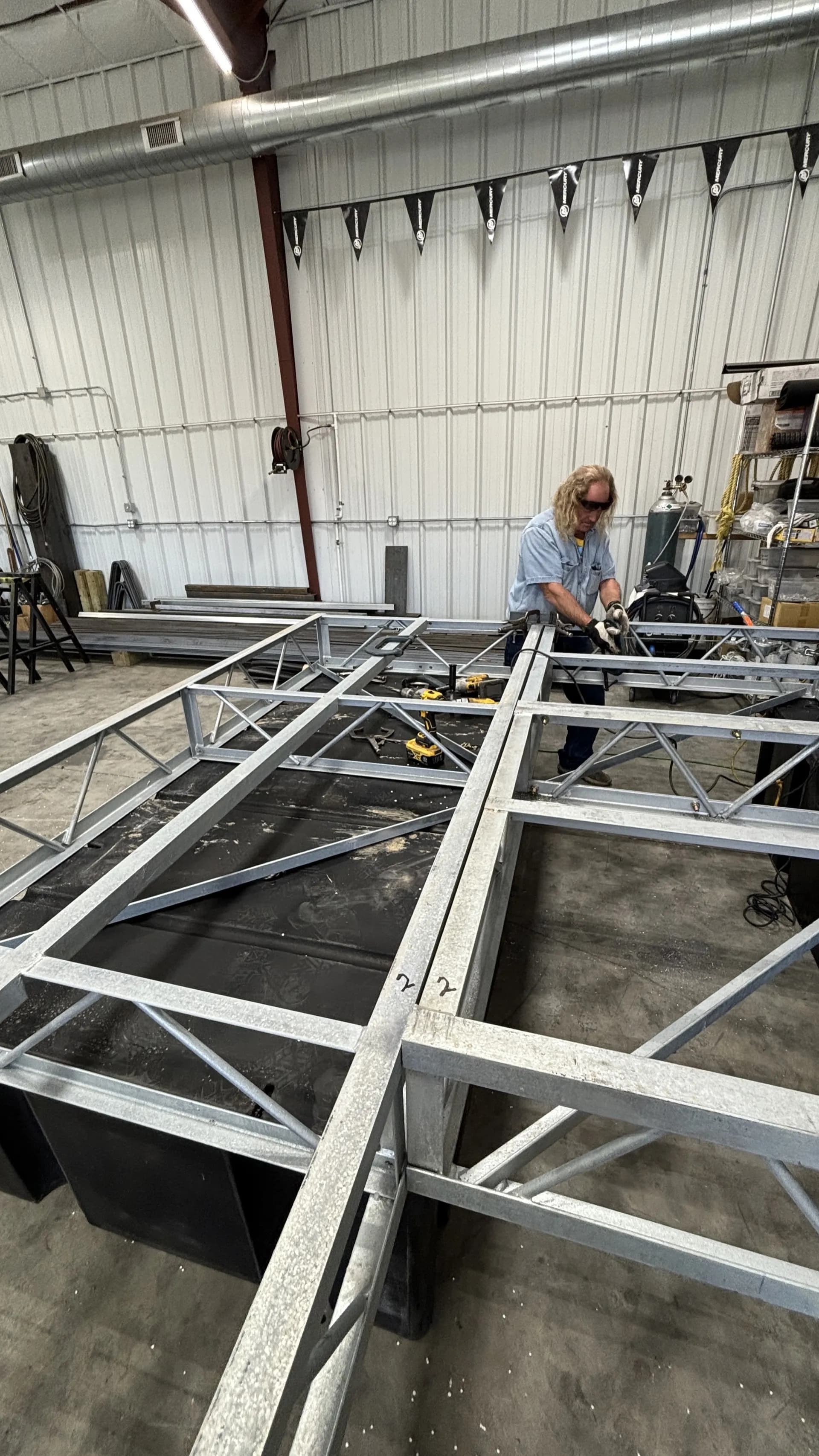
Flotation
Encapsulated foam billets carry the dock. Encapsulation matters: bare foam absorbs water, gets eaten by wildlife, and sheds beads into the lake. Saturated foam is why docks start riding low or listing.
Frame
Welded steel or aluminium carrying deck, roof, and live load. Coating quality is what decides whether you get seven years or twenty-five out of it.
Anchoring
Cables running to concrete piers set into the shoreline, usually combined with stiff arms that hold the dock off the bank. This is the system that lets the dock rise and fall while staying exactly where you put it.
Gangway
A hinged ramp from shore to dock. It has to pivot, because the lake moves and a rigid connection would tear the dock or the shoreline apart.
Decking
Wood, composite, or concrete. The choice affects cost, maintenance, surface temperature, and grip when wet more than almost any other decision.
Roof structure
Trusses and covering over the slips. Clearance is measured water to lowest truss, which is the constraint that decides which boats fit.
Floating versus fixed
Floating
- Constant height relative to the water
- Handles large seasonal level changes
- Can be reconfigured or extended later
- Flotation is a wear item and needs replacing
- Requires cable, anchor, and stiff arm design
Fixed
- Very stable underfoot
- Needs a lakebed that will take pilings
- Boarding height changes as the level moves
- Harder to modify once installed
- Rarely suitable for this lake's level swing
For almost every residential shoreline at Lake of the Ozarks, a floating dock is the right answer. The interesting decisions are about size, layout, materials, and anchoring rather than about which type to build.
Planning a residential dock
This is the order we work in, and the reasoning behind it. Most of the cost and nearly all of the regret is decided in the first three steps.
Read the shoreline
Water depth, bank slope, how the cove funnels wind, and where wake actually arrives from. This decides dock size, orientation, and whether wave attenuation is worth considering. It is the step most catalogue designs skip, and the one that causes the most regret.
Start from how you use the water
Slip count and size come from the boats. Deck space comes from whether you entertain. Swim platforms and ladders come from whether there are kids. A dock designed around a boat alone tends to get used less than one designed around a family.
Size for the next boat, not just this one
Slip length, beam clearance, roof height, and lift capacity are all far cheaper to build in than to retrofit. If a bigger boat is even possible, design the headroom now.
Work out the anchoring before the layout
Cable runs, stiff arm positions, and concrete pier locations set the real constraints on where a floating dock can sit and how it behaves. Design the deck first and you frequently have to redraw it.
Ameren approval
Ameren Missouri manages the shoreline and approves dock size, position, and configuration. As an Ameren Certified Dock Builder, permit CDB-187, we build to their standards and handle the permitting groundwork rather than leaving it to the owner.
Build, install, and walk it
Fabrication happens in our shop, installation on your shoreline, and we finish with a walkthrough so you know how the anchoring works and what to check each season.
Sitting low? That is usually the foam
A floating dock that rides low, leans to one side, or feels soft underfoot has almost always taken on water in its flotation. Foam absorbs moisture over the years, especially where encapsulation has been breached, and the dock settles unevenly as it happens.
In most cases that is a re-foaming job, not a rebuild. Our Dock Wellness Program checks flotation, hardware, and structure annually so this gets caught while it is still a repair.
Floating dock questions, answered
What is a floating dock?+
A floating dock is a dock that rides on encapsulated flotation rather than standing on pilings driven into the lakebed. It rises and falls with the water level and is held in position by cables, anchors, and stiff arms connected to the shoreline.
Why does Lake of the Ozarks use floating docks?+
Because the lake level moves. Ameren manages water levels for power generation and flood control, and the swing through a season is more than a fixed dock can comfortably accommodate. A floating dock keeps a constant relationship to the water, so boarding height and slip clearance stay the same no matter the level.
How long does a floating dock last?+
The frame is the long-lived part: a well built, well coated steel frame can run twenty-five years or more. Flotation foam and decking are the wear items. Foam typically needs replacing before the frame does, which is why re-foaming exists as a service rather than a rebuild.
Why is my floating dock sitting low or leaning?+
Almost always saturated or damaged flotation. Foam absorbs water over time, especially if the encapsulation is breached, and the dock settles unevenly as it does. It is a repair, not a replacement, in most cases. We assess the foam during a dock wellness inspection.
Are there floating dock plans I can build from myself?+
We do not sell plans, and we would be cautious about generic ones. A dock at Lake of the Ozarks has to be engineered for your specific shoreline, water depth, and exposure, and it has to be approved by Ameren before it goes in. A plan drawn for a different lake will not account for any of that.
What does a floating dock cost?+
It depends on size, slip count, roof, decking material, lift capacity, and anchoring requirements on your particular shoreline. Rather than quote a range that will not apply to you, we start with a free on-site inspection and give a line-item estimate showing exactly what drives the number.
Can a floating dock handle a boat lift?+
Yes, provided the frame and flotation are designed for the load. Lift capacity is a design input, not an accessory, so it is much better specified at the start than added to a dock that was not built for it.
Planning a dock for your shoreline?
We start with a free on-site inspection: water depth, exposure, and how you actually want to use the water. Then an honest, line-item estimate.
Schedule Your Free Inspection