
What Is a Boat Slip?
A boat slip is the designated space where a boat is parked and tied up, formed by a dock on one side and finger piers or a well on the others. Think of it as a parking space on the water: the dock is the car park, the slip is your spot.
That is the short answer. The longer answer matters if you are buying a waterfront property, sizing a slip for a boat you have not bought yet, or trying to work out whether the dock you inherited will hold what you want to put in it. This guide covers the slip types you will see at Lake of the Ozarks, how slips are actually sized, and what every part of a dock is called so you can describe a problem without pointing at it.
Types of boat slips
Most residential docks at this lake use some combination of these. The right one depends on your boat, your shoreline, and how much of the year the boat stays in the water.
Single slip
One boat, one space. The most common setup on a private residential dock. Sized to the boat with clearance on both sides so you are not fending off pilings every time the wind shifts.
Double slip
Two boats side by side, sharing a center walkway or finger. Popular with families who keep a cruiser and a runabout, or who share a dock between two households.
Covered slip
A slip under a roof. Roofs add real value at Lake of the Ozarks: they cut sun damage to upholstery and gelcoat, keep rain and leaves out, and let you work on the boat without baking. Roof height is what limits which boats fit, which is why roof raises are a common upgrade.
Open or uncovered slip
No roof. Cheaper to build, easier to permit, and better if you want an open sun deck feel. Usually paired with a canvas cover or a lift-mounted cover instead.
Well slip
A slip formed by the dock structure itself rather than by finger piers, so the boat sits in a three-sided well. Common on larger residential docks and on docks that carry a lift.
Lift slip
Any slip fitted with a boat lift so the hull sits out of the water between uses. This is the single best thing you can do for a hull at this lake. Water out means less growth, less blistering, and less time spent cleaning.
How boat slips are sized
Slips are sized by length and beam, with clearance added on every side. The mistake we see most often is measuring the boat by its model name instead of its actual dimensions.
- 01Use overall length. Include the swim platform and the outdrive. A boat marketed as a 24 footer is frequently 26 to 27 feet in the water.
- 02Add working clearance. Two to five feet of length and at least two feet of beam. You want room to board and fend off, not a shoehorn fit.
- 03Check roof clearance. Measured from the water to the lowest truss. This is the number that decides whether a taller boat fits, and it is the reason roof raises exist.
- 04Plan for the next boat. Boats tend to get bigger. Building a slip to the boat you own today is how people end up paying for a roof raise in three years.
The parts of a dock
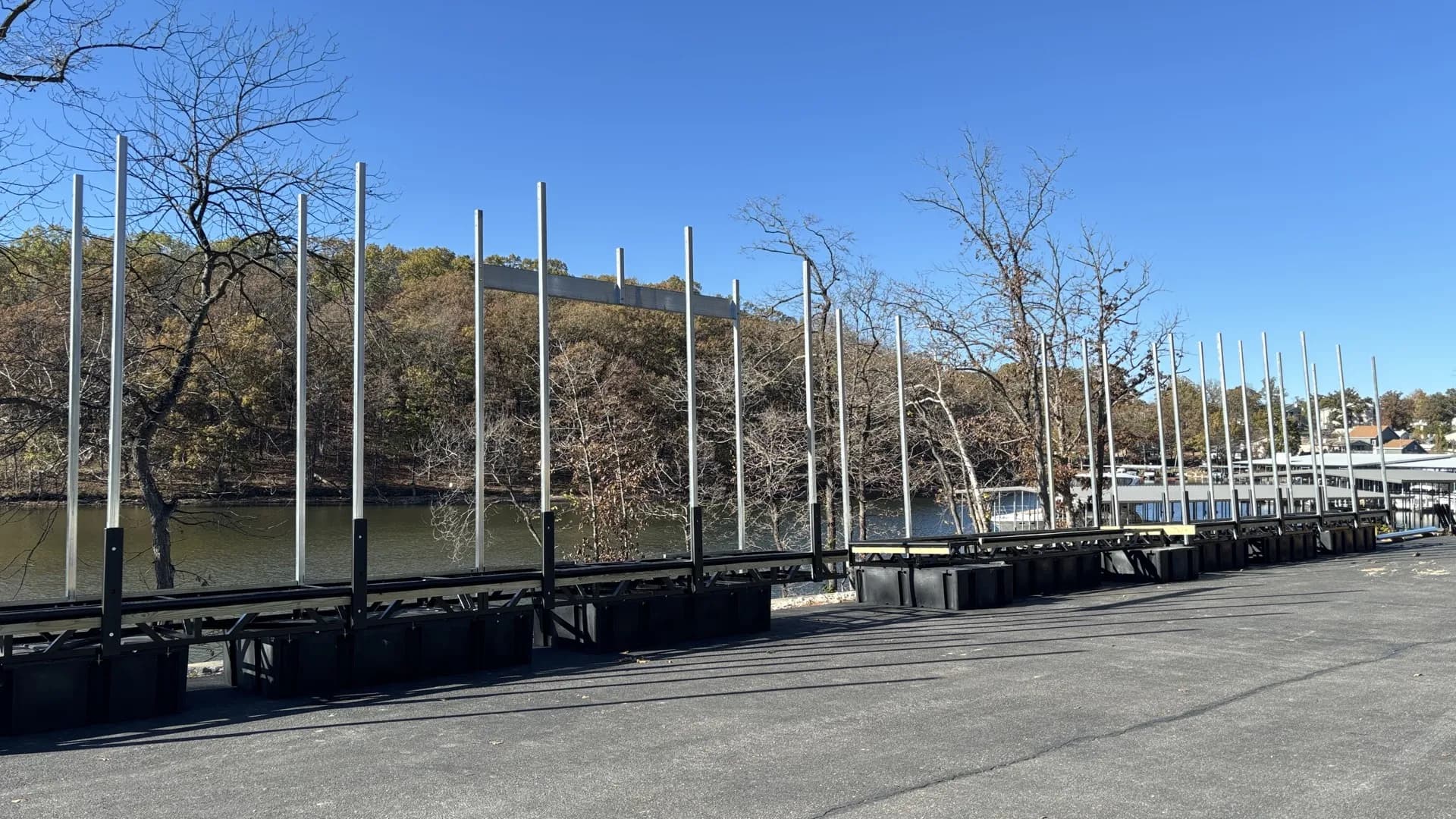
Useful vocabulary whether you are describing a problem to us over the phone or reading an inspection report. These are the components we look at on every dock wellness inspection.
- Gangway or ramp
- The hinged walkway connecting the shore to a floating dock. It has to hinge because the lake level moves; a fixed connection would tear itself apart.
- Deck
- The walking surface. Wood, composite, or concrete. This is the part you actually touch, and the part that decides how the whole dock feels underfoot.
- Flotation
- Encapsulated foam billets under a floating dock that keep it on the surface. Foam does not last forever. A dock riding low or listing to one side usually needs re-foaming, not replacing.
- Frame
- The steel or aluminum skeleton the deck and flotation attach to. Everything else is carried by this, so weld quality and coating are what separate a twenty-year dock from a seven-year dock.
- Finger pier
- The narrow walkway running alongside a slip so you can board and tie off from the side. Two fingers make a slip; one finger between two boats makes a double.
- Piling or post
- A vertical member driven or set into the lakebed that holds the dock in position. On a fixed dock it also carries the load.
- Stiff arm
- A rigid arm connecting the dock to an anchor point on shore, holding it out from the bank while still allowing vertical movement with lake level.
- Cable and anchor
- Steel cable running from the dock to concrete piers set into the shoreline. This is what actually keeps a floating dock where you put it.
- Cleat
- The metal fitting you tie lines to. Undersized or under-anchored cleats are one of the most common failure points we find on inspections.
- Bumper or dock edging
- The rub strip protecting both the dock and the hull. Cheap to replace, expensive to skip.
- Roof and truss
- The cover over a slip and the structure carrying it. Clearance height is measured from the water to the lowest truss, and it is the number that decides whether your boat fits.
Adding or changing a slip needs Ameren approval
Ameren Missouri manages the Lake of the Ozarks shoreline. Any change to a dock's footprint, slip count, or position goes through their approval process. Work done without it can be ordered out at the owner's expense.
Big Thunder is an Ameren Certified Dock Builder, permit CDB-187. We build to Ameren standards and handle the permitting groundwork, so the dock is compliant from the first drawing rather than retroactively.
Boat slip questions, answered
What is a boat slip?+
A boat slip is a designated docking space where a boat is parked and secured, usually formed by a dock on one side and finger piers or a well on the others. Owning or renting a slip means you have a reserved place to keep your boat in the water rather than trailering it each time.
What is the difference between a boat slip and a dock?+
A dock is the whole structure. A slip is one parking space within it. A single residential dock might contain one slip or four, plus swim platforms, storage, and deck space that are not slips at all.
How are boat slips sized?+
By length and beam, with clearance added. A common rule is to add two to five feet to the boat's overall length and at least two feet to its beam, then check roof height if the slip is covered. Overall length includes the swim platform and outdrive, which is where most people underestimate.
What size boat slip do I need?+
Measure your boat's true overall length, not the model number. A boat sold as a 24 footer is often 26 or 27 feet with the platform and drive. Bring us those measurements and the make and model, and we will size the slip so you are not backing into a space with six inches to spare.
Can I add a slip to my existing dock at Lake of the Ozarks?+
Often yes. Adding a slip usually means extending the frame, adding flotation, and revising the cable and anchor layout so the loads still balance. Because it changes the dock's footprint, it needs Ameren approval. We handle that groundwork as an Ameren certified dock builder, permit CDB-187.
Do I need a permit for a boat slip at Lake of the Ozarks?+
Yes. Ameren Missouri manages the lakefront and any change to a dock's size, position, or slip count requires their approval. Building without it risks having to remove the work at your own cost.
Should my slip have a boat lift?+
If you plan to keep the boat in the slip for the season, a lift pays for itself. Storing the hull out of the water reduces growth, staining, and blistering, and it makes bottom cleaning a non-issue. The slip and dock have to be built to carry the load, which is worth designing in from the start rather than retrofitting.
Sizing a slip for your boat?
Send us the make, model, and overall length. We will tell you what will fit, what it takes to get there, and what it costs. Free on-site inspection, no obligation.
Schedule Your Free Inspection